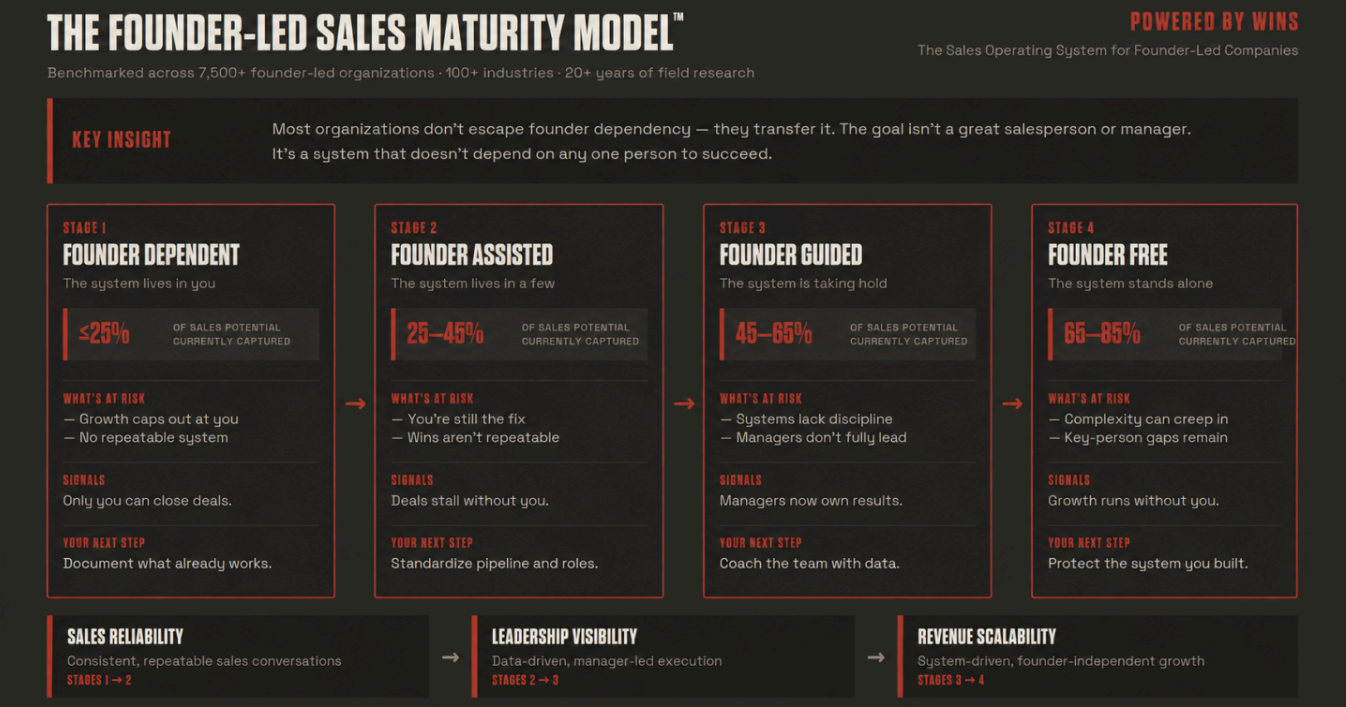
Four stages for building a Sales Operating System that grows beyond the founder
Growth should not stall when you step back
Most founder-led companies do not stall because the founder lacks talent, effort, or market knowledge. They stall because the founder's best sales instincts never become part of a scalable system the entire team can execute.
When that happens, deals move differently when you are involved. Forecasts become more credible after you review them. Managers escalate the hardest calls to you. Sellers learn that bringing you into a deal is safer than learning how to lead the buyer themselves.
At first, this feels like leadership. Over time, it becomes infrastructure. The company depends on you not only for vision, but also for sales execution.
The Founder-Led Sales Maturity Model™ helps you identify that dependency and see what must change next. It is benchmarked across 7,500+ founder-led organizations, 100+ industries, and 20+ years of field research.
KEY INSIGHT
Most organizations do not escape founder dependency. They transfer it to another top producer. The goal is not finding the rare salesperson or manager who can figure it out as you did. It is building a system that does not depend on you or any one person to succeed.
Founder Free does not mean founder absent
The goal is not to remove the founder from customers, strategy, or important decisions. The goal is to make the founder's involvement optional, not required. A mature Sales Operating System can still benefit from the founder's insight without depending on the founder to close, rescue, or move meaningful deals forward.
THE FOUR STAGES AT A GLANCE
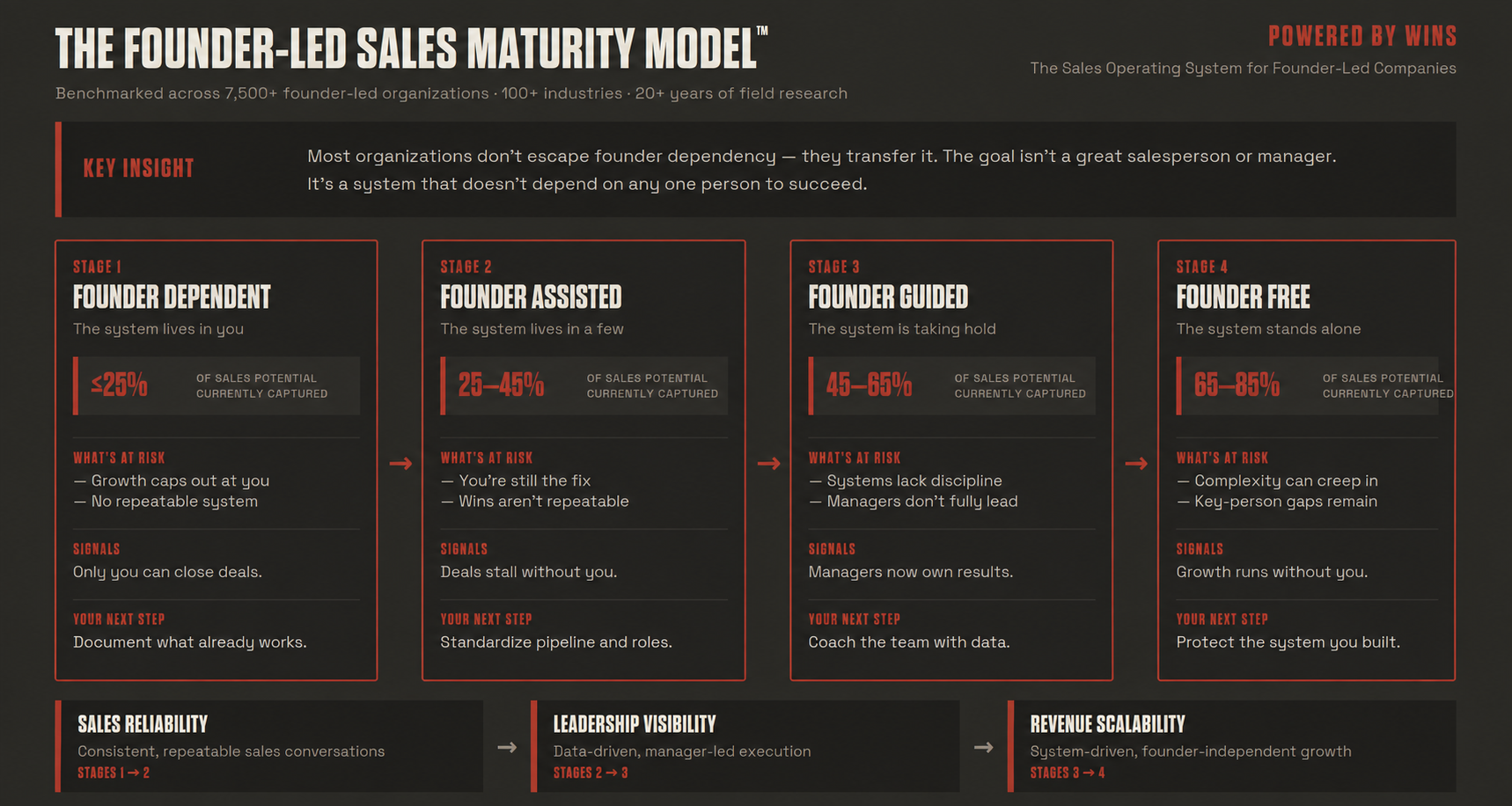
The model tracks the shift from founder dependency to sales reliability, leadership visibility, and revenue scalability.
What the model measures
This is not an org chart. It does not measure maturity by the title of the person running sales. It measures how reliably the Sales Operating System can produce results without depending on the founder or another key individual.
Each stage includes a directional range for the share of sales potential the organization is currently positioned to capture. The ranges are not revenue forecasts or guarantees. They show how founder dependency, process discipline, leadership, and cross-functional alignment can limit or expand what the organization can convert consistently.
Most companies operate across more than one stage. You may have a mature process for existing accounts and a founder-dependent process for new business. You may have capable sellers but weak management. The right stage is the earliest point where your system stops working consistently without you.
STAGE 1
Founder Dependent: The system lives in you
System state: The system lives in you
Sales potential captured: Up to 25%
Primary signal: Only you can reliably close the important deals.
Next step: Document what others can learn.
At this stage, the founder is the sales engine. The most valuable knowledge lives in your judgment, relationships, pattern recognition, and ability to create trust. Other people may support the process, but they cannot yet reproduce it.
What this stage looks like
- Important sales conversations change when you enter the room.
- Qualification, pricing, messaging, and follow-up vary by person or opportunity.
- The pipeline feels inconsistent because progress depends on your interpretation.
- New hires are expected to absorb your instincts, without a clear operating system.
What is at risk
- Growth caps out at the founder's available time and attention.
- The team has no repeatable system it can execute with confidence.
Why companies get stuck
Early success rewards speed, instinct, and trial and error. Documenting the system feels slower than doing the work yourself and hoping other team members figure it out, so the founder keeps selling while the system remains unwritten. When a team member struggles, the instinct is often to replace them instead of examining where the organization and system failed.
Your next move
Document the evidence behind what works that others can adopt. Clarify where you win, who is most likely to buy, how your best conversations unfold, what qualifies an opportunity, and why buyers change. Build a simple but accountable pipeline and forecasting rhythm that separates evidence from optimism. The goal is to turn instinct into a system others can learn and advance.
Progress looks like
Your team can identify the evidence for why a deal should advance, not simply report what they think, hope, or feel. First meetings no longer require you to be there. Pipeline reviews become grounded in evidence, and the first repeatable sales habits begin to appear.
STAGE 2
Founder Assisted: The system lives in a few
System state: The system lives in a few
Sales potential captured: 25% to 45%
Primary signal: Deals stall without you.
Next step: Standardize the pipeline and roles.
The team can now sell, but the organization still depends on the founder and a few reliable players. This can look like progress because more people are involved. In reality, dependency may have been transferred rather than removed.
What this stage looks like
- Sellers can move routine opportunities, but escalate complex or high-value deals.
- Performance varies sharply by rep, territory, or product line.
- A few heroes carry the forecast while other sellers struggle to reproduce their success.
- CRM data exists, but leaders still need private conversations to understand the real pipeline.
What is at risk
- You are still the fix when a deal becomes difficult.
- Wins depend on a few people and are not yet repeatable across the team.
Why companies get stuck
Rescue creates short-term revenue, so it is rewarded. Every time the founder or top seller saves a deal, the team learns that escalation works. The company adds people, tools, and activity, but the knowledge needed to produce consistent wins remains concentrated in a few individuals.
Your next move
Standardize how work moves through the system. Define pipeline stages, evidence-based exit criteria, roles, handoffs, qualification, account ownership, and the moments when leadership should become involved. Align territories, goals, compensation, hiring, onboarding, and CRM use around the same repeatable sales motion and measurable results.
Progress looks like
New sellers ramp against a shared playbook instead of shadowing one person. Managers can see risk earlier. The founder joins selected conversations for strategic value, not as the closer of last resort. Sales reliability begins to replace individual heroics.
STAGE 3
Founder Guided: The system is taking hold
System state: The system is taking hold
Sales potential captured: 45% to 65%
Primary signal: Managers now own results.
Next step: Coach the team with data-driven insight.
At this stage, the sales system is visible and largely repeatable. Managers drive execution, the founder guides strategy, and the pipeline is more stable. The challenge is no longer whether a system exists. The challenge is whether leaders can maintain system discipline under pressure.
What this stage looks like
- Managers run pipeline reviews, forecasts, coaching, and accountability conversations.
- The founder is rarely needed to move an ordinary opportunity forward.
- Salespeople use a shared process and language across the team.
- Forecasts are becoming reliable because CRM data reflects buyer evidence.
What is at risk
- Systems lose value when execution becomes inconsistent.
- Managers may own meetings without fully owning results.
Why companies get stuck
A founder may step back before managers are ready, or fully trained to lead. When results slip, the founder returns to directing deals and making decisions. That weakens the manager, teaches the team to escalate around the manager, and quietly pulls the organization back toward Founder Assisted.
Your next move
Coach the team with data. Give managers a practical framework for diagnosing activity, competency, efficiency, and effectiveness. Strengthen the daily, weekly, monthly, and quarterly operating cadences. Use CRM hygiene, forecasts, playbooks, and performance data to create timely coaching, clear accountability, and motivation.
Progress looks like
Managers can explain why results are happening and what must change next. Coaching is specific rather than generic. The playbook improves as the team learns. Performance is less vulnerable to one weak month, one difficult deal, or one absent leader. Leadership visibility replaces founder oversight.
STAGE 4
Founder Free: The system stands alone
System state: The system stands alone
Sales potential captured: 65% to 85%
Primary signal: Growth runs without you.
Next step: Protect the system you built.
Founder Free means the Sales Operating System can stand on its own as an aligned part of the larger revenue engine. Leaders own the forecast, managers develop people, sellers lead buyers consistently, and growth no longer requires the founder to be part of the operating process.
What this stage looks like
- The team continues to create, advance, and close opportunities when the founder steps away.
- Leaders earn trust in forecasts by sharing standards and using evidence consistently.
- Managers develop other managers and protect the system despite turnover and growth.
- All five revenue teams: brand, marketing, sales, customer experience, and product-service, develop cross-functional metrics and operate without siloes from a more unified go-to-market strategy.
What is at risk
- Complexity can creep in as the business adds teams, markets, and tools.
- Key-person gaps can remain even when founder dependency is gone.
Why companies get stuck
Maturity creates new complexity. New markets, products, leaders, and technology can introduce silos or new key-person dependencies. A system that once created freedom can become rigid, fragmented, or outdated if no one is accountable for protecting and improving it.
Your next move
Protect the system you built. Align revenue teams around shared outcomes, shared metrics, and a disciplined quarterly operating rhythm. Strengthen succession planning, leadership development, cross-functional processes, forecasting, and revenue intelligence. Keep updating the system as the company, competition, and markets change.
Progress looks like
Growth continues without your constant involvement. Leaders develop other leaders. The forecast is credible across the organization. The founder can focus on vision, relationships, capital, innovation, or any other work where their contribution creates the most value.
The three shifts that move the system forward
1. Sales Reliability
The move from Founder Dependent to Founder Assisted begins when sales success becomes visible and repeatable. This requires more than documenting scripts. It means capturing how your best people diagnose problems, build trust, qualify opportunities, create urgency, and lead buyers toward a successful decision.
2. Leadership Visibility
The move from Founder Assisted to Founder Guided happens when leaders can see what is working, what is stuck, and why. Reliable data, disciplined pipeline stages, evidence-based forecasts, and manager-led coaching allow the organization to replace escalation with accountability.
3. Revenue Scalability
The move from Founder Guided to Founder Free happens when the broader revenue organization operates as one system. Brand, marketing, sales, customer experience, and product-service teams align around the same buyers, value, evidence, metrics, and growth priorities.
How to identify your current stage
Do not choose the stage that best reflects your strongest seller or most mature department. Choose the earliest stage where the system cannot operate consistently without the founder or another key person.
- If you stepped away for 30 days, what would happen to the team’s qualified pipeline, active deals, and forecast?
- Which decisions, conversations, or approvals still return to you?
- Can the team explain why your best deals move forward and reproduce those patterns?
- Can managers diagnose performance and coach the team without waiting for your answer?
- Would the sales system survive the departure of a top seller or leader?
Your answers will often reveal that the real bottleneck is not headcount. It is the part of the operating system that still lives in one person's experience.
Start with the dependency, not the job title
Hiring a VP of Sales does not automatically create a Founder Free organization. Adding CRM does not automatically create visibility. Writing a playbook does not automatically create discipline. A company moves forward only when the system consistently changes how people sell, lead, decide, and learn.
That is why the first question should not be, 'Who should we hire next?' It should be, 'Where does our Sales Operating System still depend on the founder or key team members, and what must become transferable first?'
YOUR NEXT STEP
Before you change your team, process, or tools, identify where your Sales Operating System remains dependent on you and other key individuals.
Take the Founder Sales Dependency Assessment
In less than 10 minutes, the assessment can help reveal why deals still rely on your involvement, where the sales process breaks as you scale, and what must change first to make growth more scalable and predictable.
If the assessment points to deeper cross-functional issues, the Sales Operating System (SOS) Diagnostic can map the priority systems, resource requirements, and timeline for moving from your current stage to the next.
Growth is the shared goal. Change is the shared path. Leadership is the shared responsibility.