.png)
Executive Summary
Every organization is a reflection of how its leaders make decisions.
Early in a company’s life, decisions are fast, intuitive, and inexpensive. Leaders learn by trial and error, adjust quickly, and recover easily. But as the business grows, so do the consequences of every decision. Each choice now touches more people, systems, and customers. Each mistake costs more, lasts longer, and reaches further.
This is for leaders who are still personally carrying revenue decisions that now affect dozens or hundreds of people.
The Law of Compounding Consequence™ reveals a truth every leader eventually experiences:
“As an organization grows, the consequences of its decisions compound faster than its leaders’ ability to adapt through trial and error.”
Without deliberate investment in expertise and learning systems, decision-making risk multiplies silently beneath the surface. What once accelerated growth, the leader’s intuition, improvisation, and hustle, becomes a hidden liability as the organization scales.
Nowhere does this hidden risk surface faster than inside the revenue organization, the system that connects your customers, your salespeople, and your bottom line. Every hiring decision, every forecast, every missed follow-up compounds consequence. What once felt like minor friction between marketing, sales, and customer success quickly becomes a drag on growth velocity and valuation.
Leaders who are slow to evolve beyond trial and error create cultures that are slow to evolve. Over time, decision risk and inefficient learning become permanent features of the organization’s growth culture, normalizing risk exposure instead of containing it.
“Growth multiplies opportunity and exposure. Expertise is the only force capable of dividing that cost.”
The Law in Action:
- In small organizations, trial and error is tuition, an affordable way to learn fast.
- In growing organizations, trial and error becomes a tax, an expensive way to relearn the same lessons.
- In mature organizations, trial and error becomes a threat, an existential risk that only compounded expertise can mitigate.
The Law challenges leaders to evolve how they learn to make decisions:
- From improvisation to intention.
- From reaction to reflection.
- From solitary judgment to shared expertise.
“You can’t stop consequences from compounding. But you can make expertise compound faster. That’s the Law of Compounding Consequence – the smarter way to take risks, learn fast, and keep growing.”
The Compounding Consequence Formula™ quantifies how decision risk behaves inside an organization. The formula shows that as Consequence and Frequency rise, learning costs and risk exposure increase unless Expertise compounds faster.
“Trial and error is decision-making without insurance. Expertise is the premium that keeps you in the game.”
Learning Cost = (Consequence × Frequency) ÷ Expertise
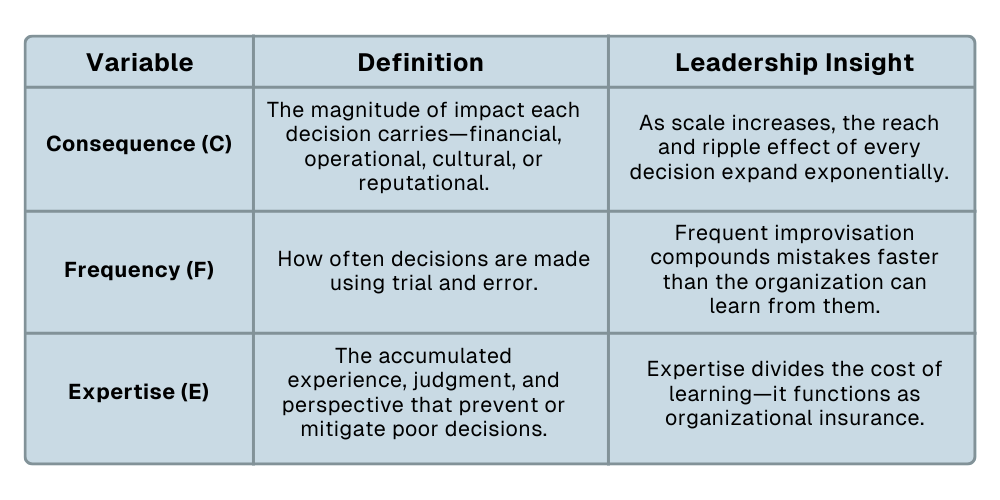
In revenue organizations, frequency shows up in every unqualified lead pursued, every forecast driven by hope instead of data, and every missed coaching moment, small repetitions of trial and error that quietly multiply cost. Expertise is what reverses that curve. When leaders codify intelligence, they turn buyer alignment, qualification, and coaching into predictable systems of learning that help teams make better decisions faster than their consequences compound.
The Compounding Consequence Curve™ illustrates how learning and risk diverge as organizations scale. At first, this risk exposure is personal: a leader’s overconfidence in what worked before. Over time, it becomes cultural, a shared overreliance on internal experience that stifles innovation, agility, and growth.
The Zone of Uninsured Risk is where the cost of learning compounds faster than the leader’s capacity to learn.
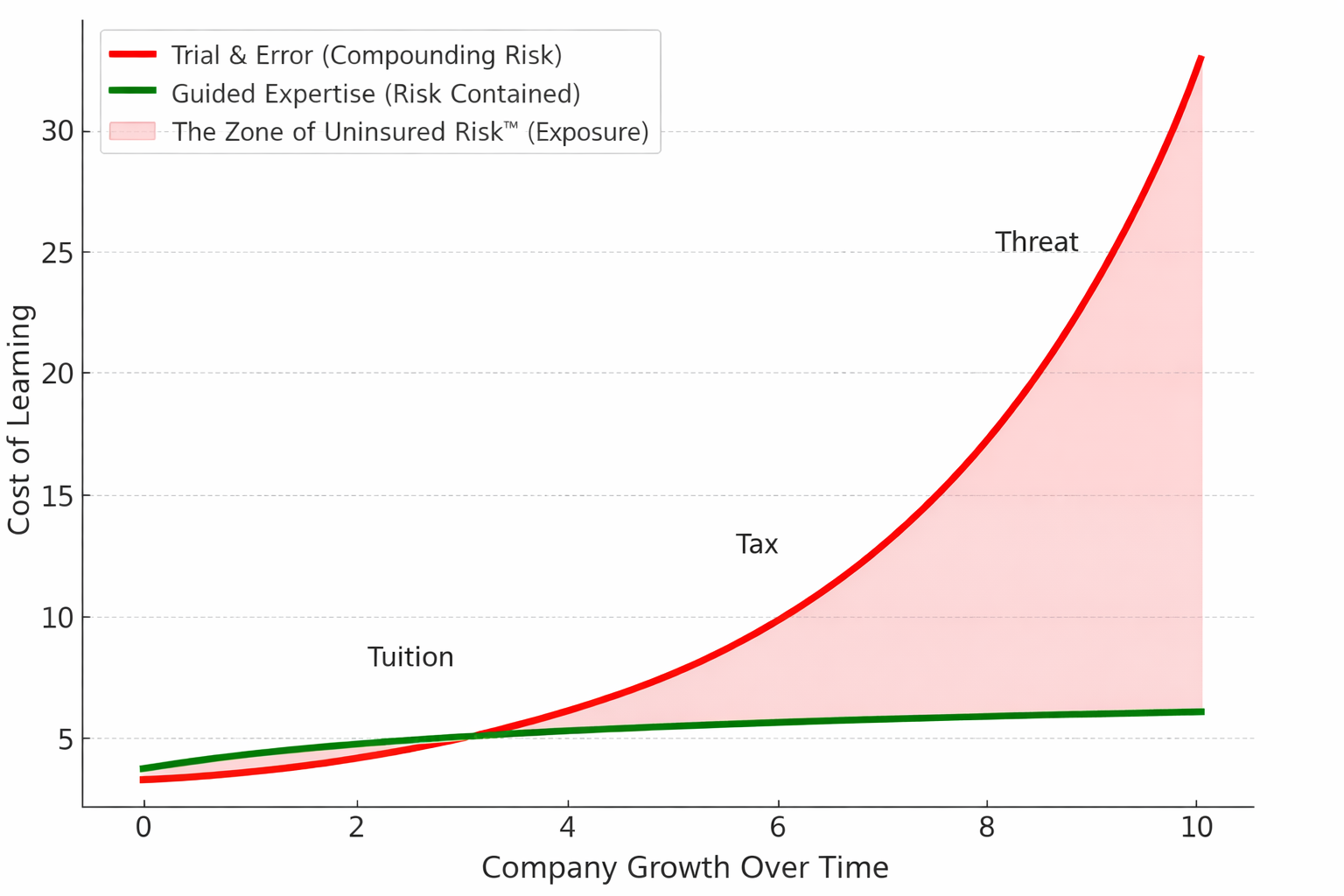
The red curve represents decision-making driven by trial and error.
- As the organization grows, the cost and risk of learning accelerate exponentially. Each error creates cascading consequences that slow momentum and erode confidence.
The green curve represents decision-making guided by expertise.
- By surrounding themselves with advisors, frameworks, and systems of reflection, leaders flatten their learning curve and contain risk.
The shaded region between them is The Zone of Uninsured Risk.
- This is the organization’s measurable area of exposure. It represents the cumulative cost of relying too long on gut instinct and force of will.
Leadership and Cultural Implications
- Growth Multiplies Decision Risk
Every level of scale amplifies the stakes of decision-making. Leaders must evolve from making decisions quickly to making them wisely, developing the appropriate amount of patience.
- Expertise Compounds Faster Than Experience
Experience reflects what we’ve lived through; expertise reflects what we’ve learned from it. Without intentional learning systems, experience compounds more slowly than consequences. - Humility and Vulnerability are Gateways to Better Decisions
Leaders who rely solely on intuition eventually become the bottleneck of their own growth. Inviting external perspectives demonstrates patience, develops wisdom, multiplies insight, and reduces exposure. - Culture Mirrors Leadership
A leader’s learning model becomes the organization’s learning culture. When leaders resist reflection, teams avoid risk-taking. When leaders seek expertise, cultures become adaptive and teams become resilient. Nowhere is leadership behavior mirrored more clearly than in the revenue organization. Sellers learn how to take risks by watching how their leaders do. If leadership improvises, the team improvises. If leadership invests in reflection and expertise, the team compounds confidence. - The Law Protects Innovation, It Doesn’t Restrict It
The Law of Compounding Consequence™ isn’t about avoiding failure. It’s about learning from it faster and smarter.
This is where codified expertise becomes essential.
Codified expertise allows organizations to learn faster than consequence compounds.
In revenue organizations, this takes the form of shared language, shared standards, and disciplined reflection. Frameworks like the WINS Model exist to transform individual intuition into a repeatable system for qualifying, aligning, and leading buying decisions, so learning compounds across the team instead of resetting with every deal.
Healthy risk-taking and innovation thrive inside organizations where learning systems are strong, reflection is normalized, and expertise compounds with experience.
“In this environment, failure becomes data, not damage. The company retains the creative agility of a startup but operates with the discipline of a market leader.”
Summary Framework
.png)
Together, these elements form a living system of leadership intelligence, a principle that can be taught, measured, and illustrated.
Closing Thought
Every decision compounds—financially, culturally, and strategically.
As leaders, we can’t prevent consequence from compounding. But we can control what compounds faster: our expertise, our humility, and our systems for learning.
That’s how leaders transform risk into resilience—and how organizations turn growth into wisdom.
The same truth applies inside your revenue organization. You can’t stop deals, forecasts, and customer expectations from compounding consequence, but you can control how your people learn from every one of them. The faster your expertise compounds, the faster your revenue stabilizes, scales, and sustains.
The Law of Compounding Consequence™ teaches leaders to make better decisions, not by growing slower, but by learning faster.
Your next step:
If this Law resonates, the real question is how your revenue system is actually learning today.
We offer a Sales Engine Diagnostic that helps leaders see:
- Where trial and error is still driving revenue decisions
- Where consequence is compounding faster than expertise
- Which parts of the sales engine are creating hidden risk
Get started for free, schedule your Sales Engine Diagnostic today.
Together,